
Two Meals…Many Meanings
Why the Passover Seder and the Christian Eucharist are not the same thing,
but have equally deep meanings.
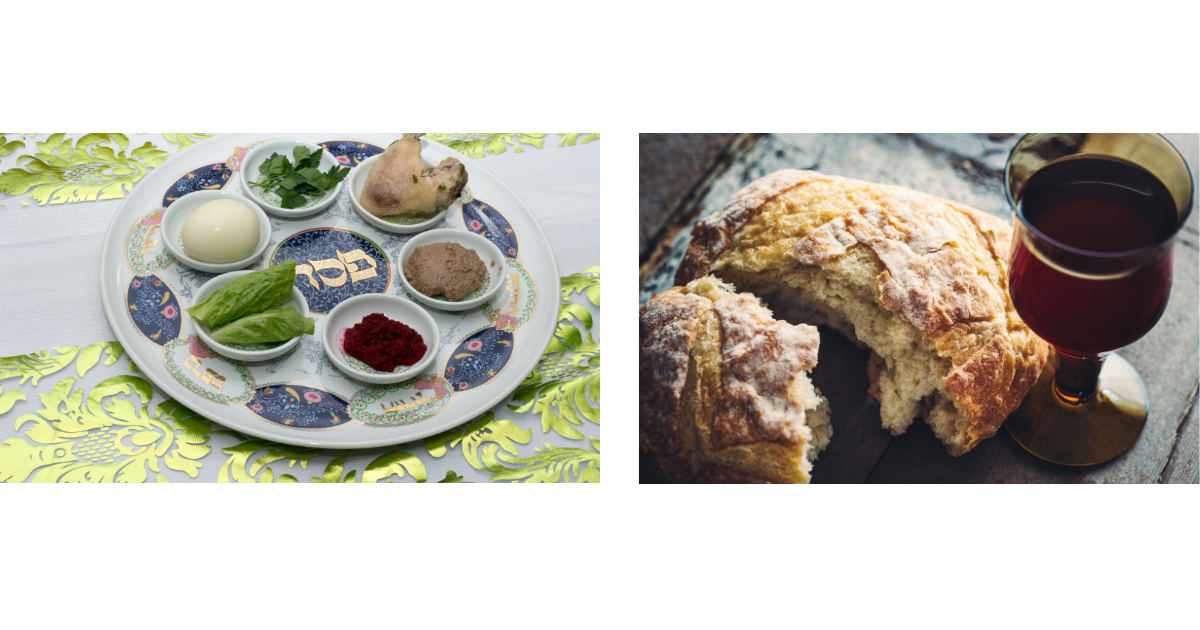
A seder plate and the elements of the Eucharist. Two different meals. Great meanings in both.
I remember the first seder I was invited to. I was nervous—am I going to have to pray in Hebrew? What if I do something wrong? Will I offend someone if I make a mistake? Little did I know that there was a book to follow, called a Haggadah, which helpfully had the prayers, actions, and songs, all written out—in Hebrew and in English! It was a wonderful meal, filled with learning the history of the Passover, and connecting with the wonderful Jewish friends who had invited me to join in their celebration.
Many years later, I was asked to preside at a “Christian Passover Seder,” as a way to connect the Jewish festival of Passover with the Christian season of Lent and Easter. I’m sad to say that I did, but afterward I learned that to do so is offensive to Jewish people, as it makes it seem like the Christian practice of Eucharist supersedes the seder. It was a gross act of cultural and religious appropriation, and I vowed never to do it again. Later, when I was ministering in England, I celebrated a “First Century Christian Meal” during Holy Week, a quasi-recreation of what a gathering in the early Church might have looked like, based on what I had learned in seminary from my Church history professor, Dr. Diane Lobody. Since then, I’ve given a lot of thought to the Passover/Easter connections between Judaism and Christianity, participated in a few more seder meals, and presided many times at the Eucharistic table. Here’s some of what I’ve learned:
What Christians call “The Last Supper” that Jesus shared with his disciples wasn’t a Passover meal, and it definitely wasn’t a seder in the way Jewish people celebrate it today.
Passover celebrates the freedom experienced by the Jewish people when the Israelites were freed from bondage in Egypt.
The Christian practice of Eucharist references Passover, but it does not supersede or “renew” the Passover for Christians.
Both meals can be very meaningful when practiced within their respective contexts.
It’s not cool to “pretend” to enact either meal—it would be just as questionable for a Jewish person to reenact a Eucharistic meal as it is for a Christian to reenact a Passover seder. It’s far better to share in these practices when invited to do so by the people of those communities.
All of that being said (or written), there is something beautiful in the sharing of food in a sacred context. In both meals, stories are told, and prayers are prayed, that evoke the Sacred and make ordinary symbols into reminders of Divine love. Christianity and Judaism are not by any means the only traditions with sacred shared meals. Many cultures and spiritual traditions gather around a table of some sort to share in food and community from time to time. Just as I have experienced the Holy in the Eucharist of my own tradition, so I have experienced the Holy in the seders I’ve attended, and in the times when I’ve been fed in gurdwaras, mosques, and temples.
The long table that we have in our dining area here at the Forest is one of my favorite spots, and I consider it sacred ground. So many wonderful, deep, and life-giving conversations have been shared over broken bread, salad toppings, and gooey desserts served at our table. It’s like a sacred feast every time we gather!
So today, whether you celebrate Passover or Maundy Thursday, or some other festival altogether, may the Peace which we extol around our tables be yours, and may your table always be filled with good food and friends aplenty!
Yours in Peace,
David